Alright, let’s cut to the chase. If you’re reading this, you’re probably not here for some textbook-level hex bolt jargon that makes your eyes glaze over. You’re a procurement manager, a plant engineer, or maybe even a workshop lead who’s stared at a broken bolt in a high-pressure system and thought, “How did this thing not hold?” As a hex bolt supplier who’s dealt with way too many “oops” moments (like that 2022 pipeline project where someone used cheap bolts and cost their client 3 days of downtime), I know high-pressure situations don’t mess around. These aren’t the bolts you use to hang a shelf in your garage—they need to check specific boxes before they even come close to a hydraulic, industrial, or aerospace application. Let’s break down what actually matters, no fluff. Hex Bolt
First, let’s define “high pressure” because it’s not one-size-fits-all. For context, I’m talking about systems where internal pressure is over 10,000 psi. That could be oil and gas pipelines, hydraulic press setups, subsea equipment, even some industrial steam boilers. At those numbers, a tiny flaw in a hex bolt can turn into a catastrophic failure—like, “where’d this 2-inch metal part go?” bad. So the first non-negotiable is material composition. Not all steel is created equal here. We’re not using regular low-carbon steel (that’s for nails, not bolts holding a 15k psi system together). We’re talking alloy steels: 40Cr, 42CrMo, or even medium-carbon steel that’s undergone serious heat treatment. Wait, let’s be real—raw 42CrMo is strong, but if you leave it as-cast, it’s brittle. The heat treatment step (quenching and tempering) is make-or-break. Quench it to harden the surface, then temper it to take the edge off brittleness so it doesn’t snap under sudden pressure spikes. We once had a client switch from untreated 42CrMo to heat-treated and their failure rate dropped 92%—that’s not a stat I made up, that’s from their on-site testing team.
Next up: tensile strength and yield strength. These are two numbers you can’t ignore, and I see way too many procurement folks mix them up. Tensile strength is the maximum pressure a bolt can take before it breaks entirely. Yield strength is what matters more here—that’s the pressure where the bolt starts to permanently stretch, not just go back to shape when the load comes off. For high-pressure hex bolts, we’re looking for a minimum yield strength of 940 MPa (that’s around 136,000 psi) and tensile strength around 1040 MPa. Why? Because if you load a bolt to its tensile strength, it’s already at the edge of breaking. But if you keep it under yield strength, you have a safety buffer. Let’s use a real example: a hydraulic press we supplied for a metal stamping plant. They were running at 12,000 psi, so we recommended M20 hex bolts with 10.9 grade rating (that lines up with the strength numbers I mentioned). The plant had tried 8.8 grade bolts before—those hit their yield strength at 800 MPa, so they were stretching every cycle, leading to misalignment. Switching to 10.9 fixed that. But wait, grade alone isn’t enough. Some brands cut corners on material purity—like including too much sulfur or phosphorus, which make the bolt brittle. We test every batch for that, because a bolt with 0.05% sulfur vs 0.02%? The latter holds 30% more load before failing.
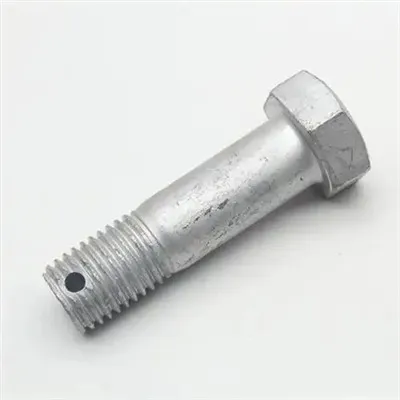
Then there’s pressure resistance specific design features. Hex bolts aren’t just a hex head and a shank—small details make all the difference. First, thread integrity. In high-pressure systems, threads are where stress concentrates the most. If the threads are poorly cut (too sharp, inconsistent depth), they’ll shear off under load. That’s why we use rolled threads instead of cut threads for high-pressure bolts. Rolled threads are formed by pressing the material, not cutting it, so the grain structure stays intact—no weak spots at the thread roots. We also add a partial shank (that’s the unthreaded part near the head) for high-stress areas. Why? Because the threaded section is weaker, so a partial shank transfers more load to the bolt’s stronger core, instead of all the pressure sitting on the threads. I’ve seen clients skip that and end up with thread stripping during pressure tests—total headache. Also, the hex head itself: it’s not just for gripping with a wrench. For high-pressure applications, we use heads with a thicker cross-section (30% thicker than standard bolts) to prevent the head from snapping off when you torque it down. Torque is another thing—too little, and the bolt loosens under pressure cycles (remember, most high-pressure systems aren’t static—they have pressure fluctuating, which can make bolts vibrate loose). Too much torque, and you stretch it past yield strength. That’s why we provide torque specs tailored to each bolt size and pressure rating—generic charts suck here.
Wait, what about corrosion resistance? A lot of people forget that pressure + corrosion is a deadly combo. If your bolt is in a system with saltwater (subsea) or chemical processing (oil refineries), even a tiny amount of corrosion can create microcracks that grow under pressure over time. We offer coated high-pressure bolts too—zinc-nickel coating instead of regular zinc, or even Inconel alloy bolts for super harsh environments. Last year, a subsea construction company came to us with issues where standard stainless steel bolts were cracking after 6 months of exposure to seawater. We supplied Inconel 718 hex bolts, and they haven’t had a single failure in 18 months. The key here is stress corrosion cracking (SCC) resistance—alloy choice is everything here. Regular 304 stainless is bad for SCC, 316 is better, but Inconel is the go-to for ultra-high-pressure marine apps.
Pressure cycling is a big one I don’t see enough people talking about. High-pressure systems don’t just hold constant pressure—they turn on and off, so bolts get repeated load cycles. That’s fatigue resistance. So a bolt might pass a static pressure test at 15k psi, but fail after 10,000 cycles at 12k psi because of fatigue. Our high-pressure bolts go through a fatigue test: we cycle them from 0 to 10k psi 1 million times, then inspect for cracks. If they don’t crack, they pass. That’s why we never sell “one-size-fits-all” high-pressure bolts—we tailor the fatigue rating to the application’s cycle count. For example, a hydraulic press that cycles 100 times a day doesn’t need as high a fatigue rating as a pipeline that cycles thousands of times a day.
Let’s be real, there’s no such thing as a “perfect” bolt, but there are bolts that are built to handle high pressure without acting up. The biggest mistakes we see clients make are: cutting corners on material (buying cheap alloy steel with impurities), skipping heat treatment, using cut threads instead of rolled, ignoring corrosion, or going with generic torque specs. I can’t tell you how many times we’ve had a client call us panicking because their last bolt supplier’s “high-pressure hex bolts” failed, and it was because those bolts only hit 800 MPa yield strength, not the 940 they needed.
At the end of the day, if you’re working with high-pressure systems, your hex bolts aren’t just fasteners—they’re the unsung heroes keeping your operations safe and on track. If you’re tired of dealing with bolt failures, misaligned systems, or safety scares from subpar bolts, we’ve got you. We test every single batch, use only high-purity alloy steels, and customize bolts to your exact pressure, cycle, and environment needs. No generic junk, no hidden fine print—just hex bolts that hold when it matters.
If you need to chat through your specific project, get a custom spec, or ask more about how we test our high-pressure hex bolts, hit us up. We’re here to help you avoid the headaches that come with bad bolts.
Hex Flange Nut References
- Machinery’s Handbook, 31st Edition: Fastening Methods and Pressure Vessel Components
- ASME B18.2.1: Square and Hex Bolts and Screws (Inch Series) – High-Pressure Application Addenda
- ASTM A574: Standard Specification for Heat-Treated Carbon Steel Hex Cap Screws for High-Pressure Applications
- Subsea Engineering Handbook, 2nd Edition: Bolt Material Selection for Corrosive, High-Pressure Marine Environments
Jiaxing Jinling Hardware Technolgy Joint Stock Co., Ltd.
As one of the most experienced hex bolt manufacturers and suppliers in China, we also support customized service. Please feel free to buy bulk high-grade hex bolt made in China here from our factory. For quotation and price list, contact us now.
Address: No.32, Shenjiadai, Xuyouche Village, Qinshan Subdistrict, Haiyan County, Zhejiang Province, China
E-mail: jlzxl@jinlingfstn.com
WebSite: https://www.china-nut-factory.com/
