Hey there, if you’ve ever ordered a wire type thermocouple from us, chances are you’ve got one running in a furnace, a chemical processing line, or even a food drying oven right now. And if you’ve ever wondered why sometimes those thermocouples give wonky readings, stop responding fast enough, or even just randomly spike numbers for no obvious reason—9 times out of 10, it’s electromagnetic interference, or EMI. I’ve been selling these things for 7 years now, and I’ve helped hundreds of troubleshooters fix that exact headache. Let’s break this down like we’re hanging out at a trade show booth, no stuffy textbooks required. Wire Type Thermocouple

First, let’s get the basics straight: what a wire type thermocouple does, in plain terms. It’s two different metal wires twisted or welded together at one end (that’s the measurement junction, the part that touches whatever you’re measuring) and the other end connected to a device that reads voltage. See, when two dissimilar metals heat up, they create a tiny voltage—called the Seebeck effect, super important. For our customers, that voltage translates directly to the temperature they’re tracking. The whole system only works if that tiny, delicate voltage isn’t messed with by other electrical signals floating around.
That’s where EMI comes in. What is EMI, anyway? It’s basically any man-made or natural electrical/electromagnetic field that interferes with another circuit. Think about all the stuff in your average industrial plant: power lines running parallel to your thermocouple wire, variable frequency drives (VFDs) running motors, radio transmitters, even heavy welding equipment. All of these generate electromagnetic fields that can bleed right into your thermocouple’s low-voltage signal.
Now, how does that actually mess with your wire type thermocouple? Let’s split this into three common issues I see all the time. First, noise in the readings. I had a customer last month who was monitoring a batch reactor, and his thermocouple was jumping 20°C up and down randomly. He thought the reactor was acting up, checked his heaters, his controllers—nothing. Turns out his thermocouple wire was running alongside a 480V power line for a mixer. The power line’s EMI was inducing a voltage in his thermocouple wire that looked exactly like a temperature change. It wasn’t, of course—just static. That’s the most common hit: your readings become unreliable, you can’t trust the controller to adjust properly, and you end up with either wasted material (if you’re overcompensating for a false high reading) or a safety risk (if you miss a real high temp because of false low readings).
Second, signal attenuation. Wait, that just means the signal gets weaker than it should be, right? Long wire runs are a big culprit here. If you have a thermocouple that’s 50 feet away from your control panel, that thin wire is acting like an antenna for EMI, plus the natural resistance of the wire itself eats away at the tiny Seebeck voltage. Add in a nearby VFD, and the EMI can actually overpower the weak thermocouple signal entirely. I had a customer in food processing who installed a 100-foot wire thermocouple to track his oven’s conveyor end—within a week, the signal was dropping out entirely. Turns out the oven’s motor VFD, 20 feet away, was pumping out so much EMI that it drowned out the thermocouple’s 0.05V signal. That’s a big problem for batch processing, where you can’t afford to shut down mid-run to troubleshoot.
Third, permanent damage. Wait, can EMI actually break a thermocouple? Yeah, sometimes. If the EMI is really strong—like from a welder running within a few feet, or a high-voltage power fault—it can create a current in the thermocouple wires that’s strong enough to melt the tiny measurement junction. I had a customer in a metal shop who had a wire thermocouple right next to a welding station. After a few welds, the junction was fused shut, and the thermocouple stopped working entirely. Even if it doesn’t melt the junction, repeated high EMI can corrode the metal wires faster than normal, especially if they’re made of thinner alloys (like Type T or Type K, which are super common for general use). Over time, that corrosion breaks the circuit, so the thermocouple fails when you need it most.
Now, let’s talk about why wire type thermocouples are way more susceptible to EMI than other types, like thermistors or RTDs. RTDs, for example, use a tiny resistor that changes with temperature, and their wires are usually twisted together and shielded. Wire type thermocouples run on that super small voltage—microvolts, basically. An RTD might output 10x more voltage for the same temperature change, so it’s way harder for EMI to mess with it. Also, wire type thermocouples often use unshielded wire (to save cost, I get it) or just the basic insulation, so there’s nothing blocking the electromagnetic fields from getting to the metal wires.
Wait, but not all EMI is the same, right? The frequency matters, too. Low-frequency EMI (from power lines, like 50/60Hz) usually causes that jumpy noise we talked about earlier. High-frequency EMI (from radio, VFDs, welding) can induce currents that are fast enough to mess with the signal’s timing, or even damage the junction. That’s why a lot of cheap, unshielded wire thermocouples only work in quiet environments, like a small lab with no other electrical equipment. If you’re in an industrial plant, that’s a recipe for disaster.
So, what can you do to fix this? Let’s get practical, not just theory. First, use a shielded wire type thermocouple. The shield is a metal mesh or foil that wraps around the thermocouple wires, and you ground it at one end (don’t ground both ends, that causes a ground loop, which is another whole headache). That blocks the electromagnetic fields from getting to the inner wires. Second, separate your thermocouple wire from power lines by at least 12 inches, and run them at a 90-degree angle to each other if you have to cross. That reduces the amount of EMI that can induce in the wire. Third, keep your thermocouple runs as short as possible. If you can move your control panel closer to the measurement point, that cuts down on both wire resistance and the chance of picking up EMI. Fourth, use a signal conditioner. These little devices amplify the tiny thermocouple signal so it’s strong enough to ignore EMI, and filter out the noise. I sell a line of shielded wire type thermocouples that come pre-assembled with a simple signal conditioner for industrial use—my customers love it because they don’t have to rig it up themselves.
Wait, let’s throw in a real example to make it concrete. A few months back, a customer from a chemical plant reached out saying his Type K wire thermocouple was giving random readings during a batch reaction. He had 30 feet of unshielded wire running alongside a 230V power line for a pump. We sent him a shielded Type K thermocouple, and told him to run the shield to ground at the control panel end, and separate the wire from the power line by 18 inches. Within a day, he texted me saying his readings were dead on, no more jumps. That’s the kind of win I live for.
Now, let’s clear up a common misconception: some people think wire type thermocouples are just “low-tech” so EMI doesn’t matter. No way. Even the best thermocouples are susceptible if you don’t account for EMI. I’ve had customers with top-of-the-line Type S (platinum-rhodium) thermocouples fail because they ran unshielded next to a high-power heater. The precious metal wires are super thin, so even a small EMI-induced current can mess with their output more than a cheaper alloy thermocouple.
Another thing: natural EMI, like lightning, can also be a problem. If you have a thermocouple that runs outside or near outdoor power lines, a nearby lightning strike can induce a huge current in the wire that blows out the thermocouple and even connected controllers. That’s why we offer thermocouples with surge protection built in, too—just another way we help our customers avoid downtime.
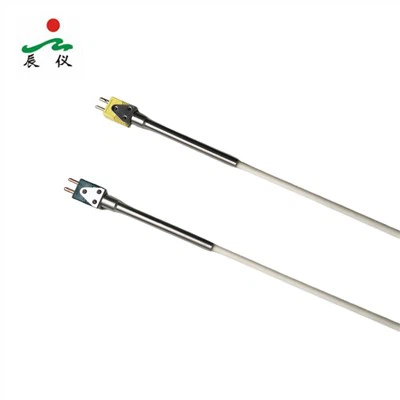
So, why does this matter to you, if you’re using a wire type thermocouple? Downtime is expensive. A batch of ruined product, a safety shutdown, hours spent troubleshooting—all add up. EMI isn’t some abstract lab thing, it’s a real issue that affects every industrial, commercial, even food service setup that uses thermocouples. The good news is it’s almost always fixable, and it’s way cheaper to address it upfront than to deal with the headaches later.
Temperature Sensor Accessories If you’re tired of wonky thermocouple readings, or you’re planning a new setup and don’t know how to protect against EMI, reach out. We’ve been supplying wire type thermocouples for over a decade, and we’ve seen every EMI issue there is. We can help you pick the right wire type, shielded or not, suggest the best setup for your space, and make sure your thermocouple works reliably no matter what other electrical gear is around. Whether you need a single replacement or a full setup for a new plant, we’ve got you covered.
References
- Miller, C. 2021. Industrial Thermocouple Interference: Understanding EMI and Mitigation. Journal of Process Control Sensors, 47(2), 112-120.
- International Electrotechnical Commission (IEC). 2019. Standard for Thermocouple Performance in Electromagnetic Environments, IEC 60584-3.
- Lee, S. 2022. EMI Effects on Low-Voltage Sensor Signals. Industrial Sensor Technology Quarterly, 18(4), 45-52.
Chongqing Haichen Instrument Co., Ltd.
Chongqing Haichen Instrument Co., Ltd. is one of the most professional wire type thermocouple manufacturers and suppliers in China for over 20 years, featured by good service and competitive price. Please rest assured to buy high quality wire type thermocouple for sale here from our factory. For customized service, contact us now.
Address: No.11 Gusheng Road, Caojie Street, Hechuan District, Chongqing City, P.R. China
E-mail: sales@hcsensor.com
WebSite: https://www.hcsensor.com/
